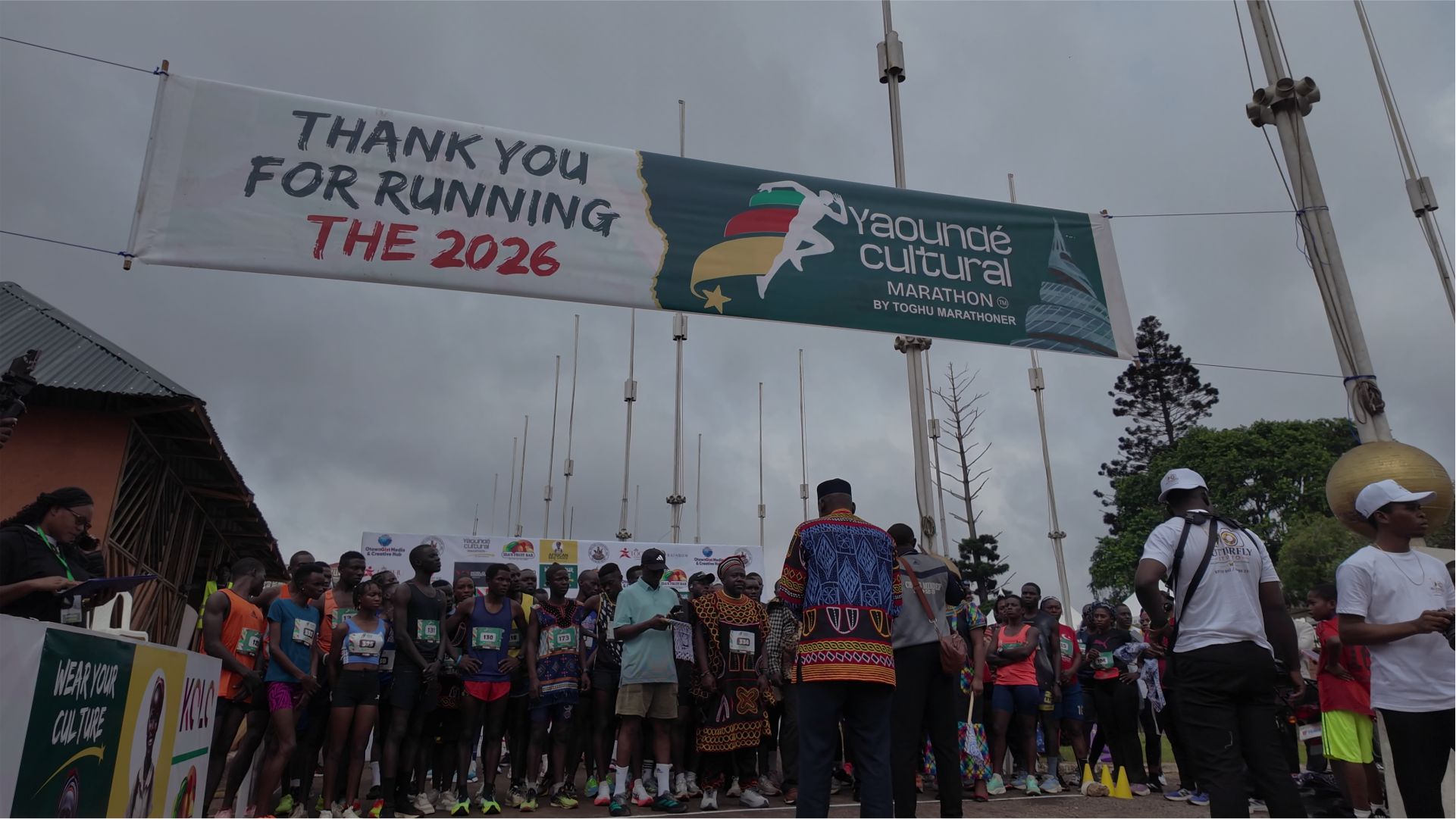
The inaugural Marathon Culturel de Yaoundé 2026 brought together children, competitive runners, families, cultural groups and participants with different access needs for a memorable celebration of sport, heritage and community.
The programme featured a 2K Children’s Fun Run, competitive 5K and 10K races, and an Inclusive Walk that created space for broader participation.
Neurodivergent participants, including autistic participants, joined the walk alongside wheelchair users, participants using crutches, and blind or low-vision participants. Their participation reflected an important principle of the event: access to sport should not be limited by age, ability or mobility.
The event also held personal significance for Afowiri Kizito Fondzenyuy, the Toghu Marathoner, who participated in the 5K. It marked his first official race on Cameroonian soil.
2K Children’s Fun Run Winners
The children opened the event with energy, determination and confidence. Their presence brought a special atmosphere to the course and demonstrated the importance of introducing young people to active lifestyles in a safe and encouraging environment.
2K Boys
| Classement | Dossard Number | Athlete | Finish Heure |
|---|---|---|---|
| 🥇 1st | 5 | Tchouala Tesso Duval | 6:36.90 |
| 🥈 2nd | 2 | Wirba Destiny Landji | 7:42.86 |
| 🥉 3rd | 14 | Effa Seraphin Nathan | 8:58.25 |
2K Girls
| Classement | Dossard Number | Athlete | Finish Heure |
|---|---|---|---|
| 🥇 1st | 3 | Alangcha Ashley Mbong | 7:55.26 |
| 🥈 2nd | 21 | Phyllis-Khalessi Nya | 10:55.25 |
| 🥉 3rd | 15 | Ngeh Dzou Lucrece | 11:09.81 |
Youngest 2K Finisher
| Special Recognition | Dossard Number | Participant | Finish Heure |
|---|---|---|---|
| 🌟 Youngest Finisher | 19 | Zahra Fondzenyuy | 18:34.47 |
Zahra Fondzenyuy’s participation was a reminder that the value of a children’s race is not measured only by speed. Confidence, participation and the courage to reach the finish line matter just as much.
5K Cultural Run Winners
The 5K race featured a strong mix of competitive athletes and community runners.
5K Men
| Classement | Dossard Number | Athlete | Finish Heure |
|---|---|---|---|
| 🥇 1st | 146 | Zakariyahu Ibrahim | 20:14.84 |
| 🥈 2nd | 116 | Halidou Hamidou | 20:39.75 |
| 🥉 3rd | 118 | Amana Engoulou | 20:47.92 |
Zakariyahu Ibrahim claimed the men’s 5K title with a strong performance, finishing ahead of Halidou Hamidou and Amana Engoulou.
5K Women
| Classement | Dossard Number | Athlete | Finish Heure |
|---|---|---|---|
| 🥇 1st | 153 | Otomo Mendouga | 23:48.75 |
| 🥈 2nd | 105 | Mai Marceline Ninsing | 24:18.10 |
| 🥉 3rd | 138 | Mongo Mbappe Princess | 25:33.59 |
Otomo Mendouga led the women’s field, followed by Mai Marceline Ninsing and Mongo Mbappe Princess.
A Personal Milestone for the Toghu Marathoner
Afowiri Kizito Fondzenyuy, widely known as the Toghu Marathoner, also completed the 5K.
Although he has participated in races and marathons around the world, the Marathon Culturel de Yaoundé marked his first official race in Cameroon. Running at home added a personal dimension to an event built around culture, belonging and community participation.
10K Cultural Course Winners
The 10K delivered some of the most competitive performances of the day, with close finishes across both divisions.
10K Men
| Classement | Dossard Number | Athlete | Finish Heure |
|---|---|---|---|
| 🥇 1st | 312 | Tchoupteng T. Franck | 34:41.67 |
| 🥈 2nd | 316 | Ruitto Matheu Kipleting | 35:11.95 |
| 🥉 3rd | 306 | Abba Sali | 35:29.85 |
Tchoupteng T. Franck secured the men’s 10K title, with the first three athletes finishing within less than one minute of each other.
10K Women
| Classement | Dossard Number | Athlete | Finish Heure |
|---|---|---|---|
| 🥇 1st | 332 | Jepkoech Marion | 37:53.61 |
| 🥈 2nd | 325 | Layu Nancy Bih | 38:36.87 |
| 🥉 3rd | 331 | Sang Beatrice Jemutai | 39:25.92 |
Jepkoech Marion emerged as the women’s 10K champion, finishing ahead of Layu Nancy Bih and Sang Beatrice Jemutai.
Inclusive Walk
The Inclusive Walk was one of the most meaningful parts of the programme.
It brought together participants with different access requirements and lived experiences, including neurodivergent and autistic participants, wheelchair users, people using crutches, and blind or low-vision participants.
| Catégorie | Participation |
|---|---|
| Inclusive Walk | Neurodivergent participants, including autistic participants |
| Mobility Access | Wheelchair users and participants using crutches |
| Visual Access | Blind and low-vision participants |
| Community Participation | Children, families, support persons and community members |
The walk reinforced the event’s commitment to creating a sporting environment in which participants are welcomed, respected and supported.
Participation was not presented as an act of sympathy. It was a legitimate and valued part of the event.
Cultural and Special Recognition Awards
The Marathon Culturel de Yaoundé was not only about finishing times. Participants were also recognised for cultural presentation, longevity in sport and their contribution to the character of the event.
Best Costume Awards
| Award | Dossard Number | Recipient |
|---|---|---|
| 🥇 Best Costume – Homme | 151 | Fomban William Gana |
| 🥈 Best Costume – Femme | — | Mofogne Adeline |
These awards recognised participants who expressed cultural identity through their attire while taking part in the event.
Oldest Competitor Awards
| Award | Dossard Number | Recipient |
|---|---|---|
| Oldest Femme Competitor | 165 | Ademego Chantal |
| Oldest Homme Competitor | 151 | Fomban William Gana |
Their participation demonstrated that community running can remain accessible and meaningful across generations.
More Than a Course
The Marathon Culturel de Yaoundé was created as a platform where sport and culture could meet without excluding people based on age, experience or access requirements.
Children ran their first races. Competitive athletes pursued podium positions. Families supported one another. Participants wore traditional clothing and cultural designs. The Inclusive Walk expanded the event beyond conventional race categories.
The result was not simply a sporting competition. It was a community experience built around visibility, participation and belonging.
The inaugural edition established a strong foundation for what can become an important annual event in Cameroon.
Everyone runs. Everyone wins. We celebrate culture.
The Marathon Culturel de Yaoundé has come to stay.
Congratulations to every winner, participant, volunteer, partner, support person and spectator who contributed to the success of the event.
Leave a Reply